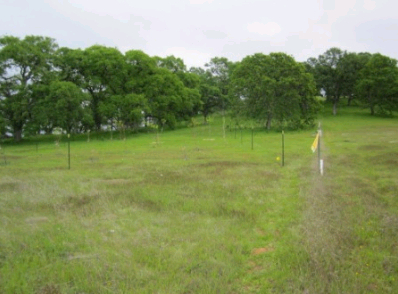
"Deer Proofing your Yard and
Garden" is a book by Rhonda Massingham Hart that came out in 1997 and
is chocked full of relevant research on understanding deer and their
habits.
I agree with her conclusion
that deer are very adaptable, and an effective deterrent system should
use multiple methods of making the deer feel unsafe. That's the main
reason why my current deterrent design uses motion in conjunction with
sound.
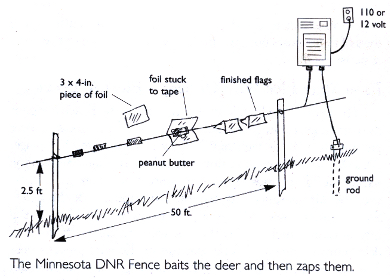
The picture above shows how
to set up a simple electric fence barrier with a shocking peanut butter
surprise. I think this would be a good backup to a mechanical
deterrent for folks who don't have a dog, but our Lucy would most
likely find it first and we want her to continue to patrol the
perimeter.
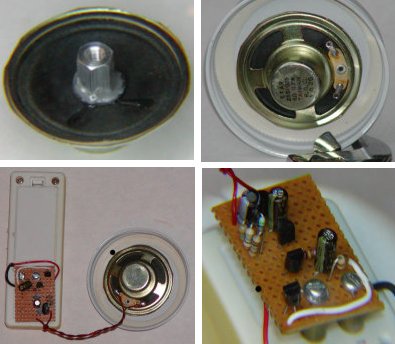
It detects seismic vibrations
from a person or large animal and then sets off a wireless doorbell
buzzer for a few seconds to startle whover is nearby.
They label it as a deer
repellant for the garden, but I would be concerned about the protective
range this thing has. It might work for a garden with low level deer
traffic and maybe just one entrance, but our large perimeter here would
require dozens of these to cover the whole area. There's no data
presented about testing on a real garden, so I would think twice about
this approach before investing too much time in it. In fact I feel
pretty confident you would get better results with my current design no
matter what situation you have, but that's just me.
I learned from reading Jim
Arnosky's excellent
juvenile book "All About Deer" a key element that must be fully
understood by the back yard deer deterrent maker.
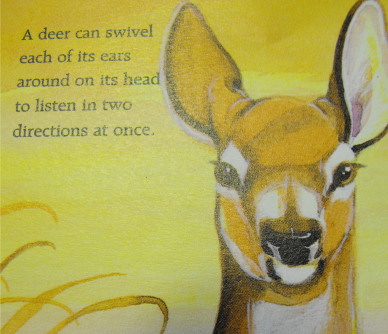
"A deer can
swivel each of its ears around on its head to listen in two different
directions at once."
This fact indicates that even
the smallest garden could benefit by deploying at least two deterrents
at each end of the protected area.
In my opinion the sound puts
a deer in caution mode, but it's the movement that usually provokes
bolting.
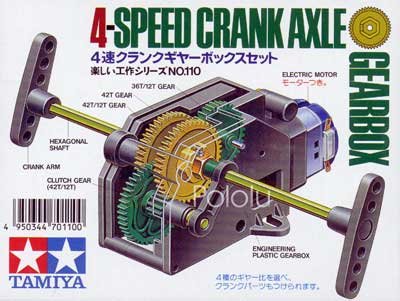
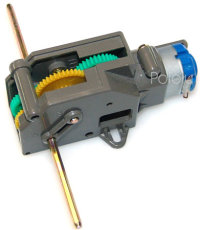
This is what your basic DC
motor gearbox looks like. The gear configuration helps to slow it down
and provide more torque than just the motor spinning by itself.
The instructions that came
with the kit are a challenge to understand. Luckily they have great
illustrations to guide you in the right direction.
You can arrange the gears in
a way that gives you 4 choices of speed. Consider this an advanced
project. Those gears are small and you really need to get it just
right for a smooth operation. It took me about 2 hours of messing with
it to finally get some decent results. If you do order this kit you
might want to add on one of their DC transformers for only 5 bucks.
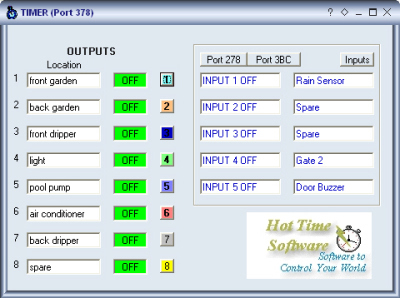
If you've got an old computer
laying around it might be possible to use it as a dedicated multi timer
control center.
Timer
5.0.0 provides the
ultimate control of up to 24 channels via 3 printer ports. The program
enables your home computer to control relays, solenoids, pumps, or
whatever you can imagine.
It's too complex of a
solution for my tastes, but some of you out there might start with a
timer for your deer deterrent and find out how much fun it might be to
control your sprinklers and security lights once you've got the system
in place.
I could see this also
controlling an automatic
chicken coop doorby
customizing each day's close time to account for the changing bed times
through the year.
I've been reading African-American
Gardens and Yards in the Rural South --- more on the gardening
aspects of the book next week on our homestead blog --- and was intrigued to
find a section on deer deterring. The author, Richard Westmacott,
interviewed 47 gardeners in Alabama, Georgia, and South Carolina, and
discovered that deer were a big problem in most of their gardens.
The usual scare tactics were tried, most of which
didn't work. But the gardener who invented this unique method
said that it did work:
Sadie Johnson (Alabama) used rags soaked
in human urine to discourage the deer. She said it is extremely
effective. "[The deer] they'll eat the peas but I got a problem
for the deer, they can do nothing with me. I put sticks out and
saved the chamber lye over-night and I'd put them sticks around and
pour that chamber lye on old rags and they didn't bother my
crops. I'd tack the rags to the sticks so the wind wouldn't blow
them off and about every other day when I had the chamber lye, go
'round and pour it on them rags."
We've tried peeing
around the garden with little luck, but I can see how Sadie's method
makes the smell go much further. If you live out in the country
and are desperate, this method might be worth a shot!
Grandpa Brock built a deer
deterrent that works on exactly the same
principle as ours --- many thanks to his
grandson for pointing me in
the direction of the embedded youtube video. If you watch through
to the end, you'll notice that Grandpa Brock adds a pebble to the can
to mix up the sound a bit. We're coming to realize that minor
adjustments like this are enough to keep the deer on their toes and out
of the garden.
Transport
Canada didn't focus on deer
deterrents as a way to keep deer out of
airports.
Instead, they concluded "In most cases, the use of deer deterrent
techniques should be used
only to provide temporary control until a more permanent solution, such
as fencing, removal or killing, can be found." So far (knock on
wood),
we've found our deterrents to be a permanent solution. But we're
just
now reaching the end of our first twelve months. So, in case
Mark's clangers fail, here are Transport
Canada's top recommendations
for more permanent control:
Habitat modification can
be used to reduce an area's attractiveness to deer. "Typical
actions include the pruning or removal of trees and shrubs; and the
removal of standing water (ponds, ditches, puddles), alteration of
grass heights, selection of broad-leaved herbaceous plants (forbs) for
planting, and paving. The main goal is to reduce the airport property's
attractiveness to wildlife." This is probably a good idea at an
airport, but clearly isn't going to cut it here on the homestead where
we're actively working to encourage most wildlife.
Fencing is Transport
Canada's primary recommendation for a permanent solution. They
recommend that deer fences be 10 feet tall and consist of galvanized
steel chain-link or high-tensile fixed-knot. On the other hand,
they note that electric fences "are effective in excluding deer under
favourable conditions, but they will be penetrated when deer are
motivated to cross them, when short-circuited by tall plant growth, or
if snow accumulations exceed the height of the lower electric
lines."
I don't doubt that a ten foot tall chain-link fence would keep the deer
out, although I do doubt that I could ever afford to fence in our two
acre garden and orchard to this level.
The entire article is
interesting reading, and I recommend you start
from the beginning and browse the whole thing. Thanks again
for sharing, Dave!
Dave
left a comment a couple of weeks ago linking to Transport
Canada's Deer Exclusion Devices and Deterrent Techniques. While we were
researching our own deterrent, I read a similar document
put out by a U.S. state (can't remember which one) noting the best way
to keep deer off airport runways. It sounds like airports are
working hard to find a way to deter deer!
I've excerpted a few of
Transport Canada's key findings about deer deterrents since they match
our experience:
"The
key to success when using frightening methods and repellents is to use
them at the first sign of a deer problem." This has been our
experience as well. Once deer find that tasty strawberry plant,
it's going to take a lot more than a gentle clanging to chase them
away. But if you deter the deer before they find your garden's
tasty crops, they will keep out.
"The
general obstacle to the use of sound for effective animal control is
habituation.
Many animals adapt to new sounds and learn to ignore them if they are
not associated with real danger.... Shooting has been used to
frighten or kill deer in agricultural fields.... In these situations,
deer are often killed to reinforce the effectiveness of non-lethal deer
scaring devices." I have to admit that I back up our deer
deterrents with a bit of hunting, and I think it helps.
"Gas
cannons can be more effective at dispersing deer if the frequency of
the explosions is varied and if the cannons are moved every second or
third day of use to a different area.... Motion-activated
exploders, triggered by passing deer were more effective than exploders
that fired at regular intervals. Thus, the exploders only fired
when a deer was close by, which made habituation less likely."
We're not using cannons (boy was someone desperate!), but Mark is
working on making our deer
deterrents less
regular to get the same effect.
Transport
Canada notes that ultrasonic noise, reflecting surfaces, and blinking lights
don't work.
That's been our experience as well. They note that odor and taste-based
repellents "are only
even partially effective at protecting very small areas."
Stay tuned for more gems
from Transport Canada later in the week!
We're always looking for
innovative ways to keep deer out of the garden, so I thought I'd share
this example from the blogosphere. Freshman
Farmer writes:
Last year we tied 80 pound test fishing
line between posts around the
vegetable field and it kept the deer out. They can’t see the fishing
line and it freaks them out.
That does sound like
quite a simple solution, although I'm sticking to Mark's deer deterrent since it is proven in our
high deer pressure area. If anyone else has tried out fishing
line, though, I'd like to hear about your results!

 Dave
left a comment a couple of weeks ago linking to Transport
Canada's Deer Exclusion Devices and Deterrent Techniques. While we were
researching our own deterrent, I read a similar document
put out by a U.S. state (can't remember which one) noting the best way
to keep deer off airport runways. It sounds like airports are
working hard to find a way to deter deer!
Dave
left a comment a couple of weeks ago linking to Transport
Canada's Deer Exclusion Devices and Deterrent Techniques. While we were
researching our own deterrent, I read a similar document
put out by a U.S. state (can't remember which one) noting the best way
to keep deer off airport runways. It sounds like airports are
working hard to find a way to deter deer!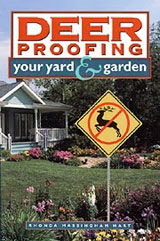 I agree with her conclusion
that deer are very adaptable, and an effective deterrent system should
use multiple methods of making the deer feel unsafe. That's the main
reason why my current deterrent design uses motion in conjunction with
sound.
I agree with her conclusion
that deer are very adaptable, and an effective deterrent system should
use multiple methods of making the deer feel unsafe. That's the main
reason why my current deterrent design uses motion in conjunction with
sound.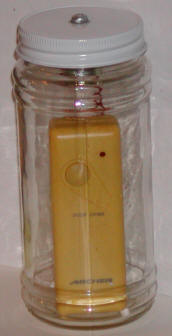
 I've been reading